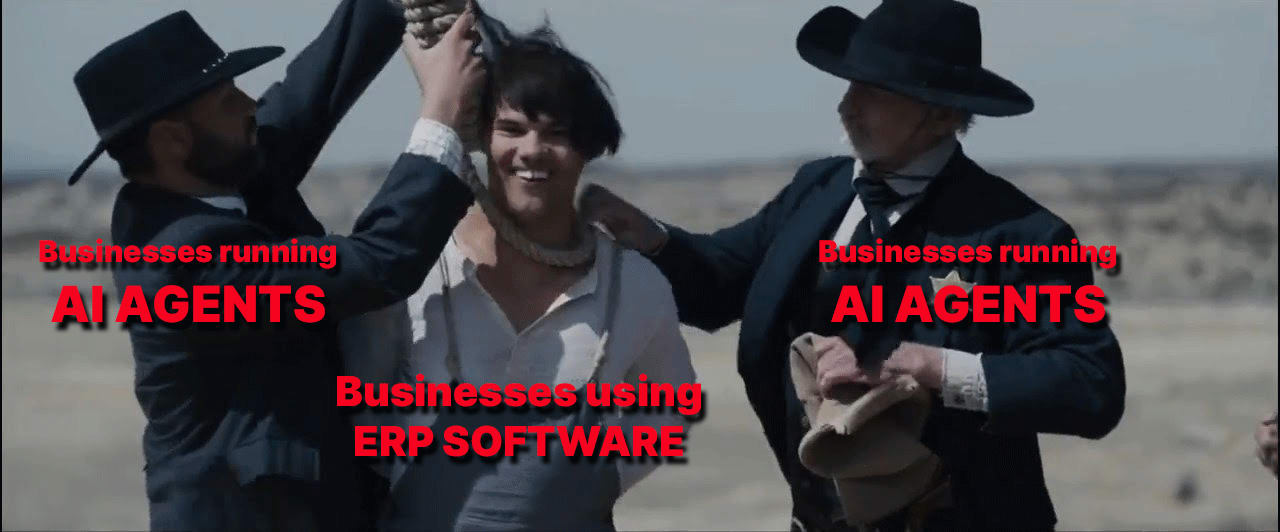
Imagine hiring a very expensive personal assistant who does only one thing: takes notes.
They write down every meeting, every deal, every complaint, every invoice — perfectly. But when you ask them to follow up with a client, send a reminder, or shortlist candidates for a role, they say: "That's not my job. I just take notes."
That is your ERP system.
And according to the data, most businesses are paying a fortune for a very expensive note-taker — while their competitors are using AI that actually does the work.
The Honest Numbers on ERP Systems
Before we talk about what's replacing ERP, let's talk about what ERP actually delivers — in numbers.
Only 26% of employees actively use the ERP system their company paid to implement. That means for every 4 people at your company, 3 of them have found a workaround — a spreadsheet, a WhatsApp group, a sticky note — because the ERP is too painful to use daily. (Source: NetSuite, 60 Critical ERP Statistics)
55–75% of ERP implementations fail to meet their stated objectives. Gartner puts it even more bluntly: 70% of ERP implementations over the next three years will fail to meet their goals. (Source: Gartner, KPC Team)
64% of companies exceed their ERP budget — with average overruns of 25–40% above initial estimates. For manufacturing companies, the average cost overrun hits 215%. (Source: Statista)
The average ERP implementation takes 18 months — and even that is 30% longer than what companies originally planned. (Source: DocuClipper ERP Statistics 2025)
These are not edge cases. This is the industry standard.
Problem 1: The Person Who "Knows How to Use It"
If your company has one employee who "knows how to use the ERP," that is not an asset. That is a single point of failure wearing a lanyard.
It means:
- Your system requires tribal knowledge to operate
- When that person is on leave, work slows down
- When they quit, you are starting from scratch
An intuitive system doesn't need a dedicated translator. The fact that yours does tells you everything about whether it was built for people — or built for consultants to bill hours on.
Problem 2: Data Migration Is the Industry's Dirty Secret
Moving from an old system to a new ERP is supposed to be the solution. In practice, it is often worse than the problem.
Here's what typically happens:
- Years of legacy data in formats that don't match the new system
- Manual cleaning and re-entry that takes months
- High risk of data loss or corruption during transfer
- Expensive consultants who charge by the hour to do what should be automated
The result? Companies stay stuck with bad systems because migrating away from them costs more than tolerating them. It's the business equivalent of living with a leaky roof because fixing it is too expensive — so you just buy more buckets.
Problem 3: Your Stack Is a Jigsaw With Missing Pieces
The average business today runs something like this:
| Tool | Purpose |
|---|---|
| ERP | Records and compliance |
| CRM | Sales leads and follow-ups |
| Email tool | Communication |
| WhatsApp/SMS platform | Customer messaging |
| Spreadsheets | Everything the ERP can't do |
None of these talk to each other seamlessly. So your team manually syncs data between them — copy-pasting, re-entering, and double-checking across five systems.
The productivity cost is enormous. The average office worker spends 40%+ of their time on repetitive tasks that could be automated, including manual data entry and copying between systems. Nearly 60% of workers say they could save 6 or more hours per week — almost a full workday — if these tasks were automated. (Source: Smartsheet Automation Study)
And the data quality consequences? Bad data costs organizations an average of $12.9 million annually. (Source: Gartner)
Problem 4: ERP Stores. It Does Not Act.
This is the core problem that nobody in the ERP sales pitch will tell you.
ERP systems are brilliant at three things:
- Storing data
- Showing dashboards
- Generating reports
They are not built to:
- Take actions
- Trigger follow-ups
- Make decisions
- Execute workflows
Think of it like a GPS that tells you where the traffic jam is — but doesn't reroute you around it. You still have to do that yourself.
Every missed follow-up, every delayed payment reminder, every candidate who fell through the cracks — that's the execution gap that ERP was never designed to close.

What Is Actually Replacing ERP: AI Agent Systems
An AI agent is not a chatbot. It is not a search bar inside your software.
An AI agent is a system that can receive instructions in plain language and complete tasks end-to-end — without a human doing the actual work in between.
The difference in practice:
Old way (ERP): You log into the system → filter the data → export the list → email the candidates → manually track responses → update the CRM → remind yourself to follow up next week.
New way (AI agent): You type: "Shortlist candidates with 3+ years of experience in logistics and send them an intro email." Done.
More examples of what this looks like in a real business:
- "Follow up with all leads who haven't responded in 7 days"
- "Send payment reminders to customers with invoices overdue by more than 15 days"
- "Flag any supplier invoice that's more than 10% above the average for that category"
- "Generate a weekly sales summary and send it to the team every Monday at 9am"
The AI doesn't need a dashboard, a login tutorial, or a training session. It needs a clear instruction.
Even Data Migration Is Getting Fixed
One of the strongest reasons businesses stay locked into bad ERP systems is data migration pain. Moving years of historical data across systems is risky, slow, and expensive.
AI is changing this too.
With modern AI-driven migration tools:
- Data can be cleaned automatically before the transfer
- Fields can be intelligently mapped across different formats and schemas
- Errors and duplicates can be flagged and resolved without human review of every row
What used to be a 6–12 month consulting project can now be executed in days to weeks.
The Market Has Already Decided
The numbers on AI adoption in enterprise operations tell you where this is going.
The global AI agent market is growing at a 46.3% CAGR — from $7.84 billion in 2025 to a projected $52.62 billion by 2030. (Source: Information Matters, Agentic AI Market Outlook 2026)
The AI-integrated ERP market alone is projected to grow from $5.82 billion in 2025 to $58.7 billion by 2035 — a 26% CAGR. (Source: Precedence Research)
Gartner predicts that 40% of all business applications will include task-specific AI agents by the end of 2026 — up from less than 5% in 2025. That is an 8x jump in a single year. (Source: Gartner, via Beam AI Enterprise Trends 2026)
The businesses building on AI agent infrastructure today are not early adopters. They are setting the baseline that everyone else will have to catch up to.
Traditional ERP vs. AI Agent Systems: At a Glance
| Traditional ERP | AI Agent System | |
|---|---|---|
| Primary function | Store and display data | Execute tasks and decisions |
| Interaction method | Menus, forms, dashboards | Natural language |
| Training required | Extensive | Minimal |
| Integration | Fragmented across tools | Unified |
| Follow-up capability | None — human must do it | Automatic |
| Data migration | Months, expensive | Days, AI-assisted |
| Adoption rate | ~26% of employees | Conversational — anyone can use it |
The Real Risk Is Not AI. It's Inertia.
The most dangerous belief in business right now is: "We'll wait until AI matures a bit more."
The technology is not the risk. The risk is the 18 months, 64% budget overrun, and 70% failure rate you're signing up for every time you double down on a system that stores data but doesn't execute work.
Your competitor who just told their AI agent to "follow up with all pending leads" didn't wait for the system to mature. They just talked to it.
Frequently Asked Questions
1. Why do ERP implementations fail so often? The most common causes are underestimating project staffing (38% of failures), scope creep (35%), and technical or data issues (34%). But the deeper cause is simpler: ERP systems are designed for how businesses imagined they worked, not how they actually work. (Source: Panorama Consulting Group, 2025 ERP Report)
2. What is the ERP failure rate? Between 55% and 75% of ERP projects fail to meet their objectives, depending on the study. Gartner specifically projects that 70% of implementations over the next three years will fall short of their goals. This is not a recent problem — it has been the industry norm for over a decade.
3. How much does ERP implementation actually cost? Far more than quoted. 64% of companies exceed their original ERP budget, with average overruns of 25–40%. For manufacturing environments, the average overrun reaches 215% of the original estimate. Implementation timelines also run 30% longer on average. (Source: Statista ERP Budget Overrun Data)
4. What is an AI agent and how is it different from a chatbot? A chatbot answers questions. An AI agent completes tasks. When you tell a chatbot "follow up with all pending leads," it might give you a template. When you tell an AI agent the same thing, it actually sends the follow-ups. The distinction is the difference between a receptionist who takes messages and one who handles your calendar.
5. Can AI agents replace ERP systems entirely? Not always immediately — especially for compliance-heavy industries that require specific record formats. But AI agents are already replacing the execution layer of ERP (workflows, follow-ups, approvals, notifications), and the integration market is moving fast. By the end of 2026, Gartner expects 40% of business applications to include task-specific AI agents.
6. What is the difference between ERP and AI agent systems? ERP systems are record-keeping and reporting tools. AI agent systems are execution engines. An ERP tells you that 47 invoices are overdue. An AI agent sends the reminders, logs the responses, and escalates the ones that didn't reply — without anyone touching a keyboard.
7. Why don't employees actually use ERP systems? Because they're not intuitive. The average ERP requires structured inputs, specific navigation paths, and dedicated training. Only 26% of employees actively use their company's ERP. The rest rely on spreadsheets, WhatsApp threads, and informal workarounds — not because they're resistant to technology, but because the ERP is harder than the workaround.
8. How do AI agents handle data migration from old ERP systems? AI-assisted migration tools can automatically clean inconsistent data, map fields across different formats, identify duplicates, and flag anomalies for review. What previously required months of consultant hours can often be done in days. This removes one of the biggest psychological barriers to switching.
9. Is ERP software becoming obsolete? Traditional, static ERP is under serious pressure. The AI-integrated ERP market is growing at 26% CAGR and is projected to reach $58.7 billion by 2035 — meaning the ERP vendors that survive will be the ones that embed AI execution capabilities, not just data storage. (Source: Precedence Research)
10. How long does it take to switch from ERP to an AI agent system? It depends on complexity and data volume, but AI-assisted migration significantly compresses the timeline. Traditional ERP migrations average 18 months. AI-augmented transitions to agent-based systems can be completed in weeks to a few months, with far lower consultant dependency.
11. What kind of businesses benefit most from AI agents? Any business where humans are spending time on repetitive tasks — follow-ups, reminders, data entry, report generation, or routing requests between tools. The businesses seeing the fastest ROI are typically in sales, operations, HR, and customer service, where the volume of routine decisions is high and the cost of delayed action is measurable.
12. What does an AI agent system actually look like day-to-day? You interact with it the way you'd message a capable colleague. You say: "Send payment reminders to everyone overdue by more than 15 days, but skip the three clients we're renegotiating with." It does it, logs what it sent, and reports back. No logins, no menus, no dashboards to interpret. Just a task given and a task completed.
The gap between businesses that execute automatically and businesses that execute manually is widening every quarter.
The question is not whether AI agents will become standard in business operations. The question is whether you get there before your competitors do — or after.
Want to see what this looks like for your specific workflows? Send a message on WhatsApp — no pitch deck, just a conversation about what's actually possible.