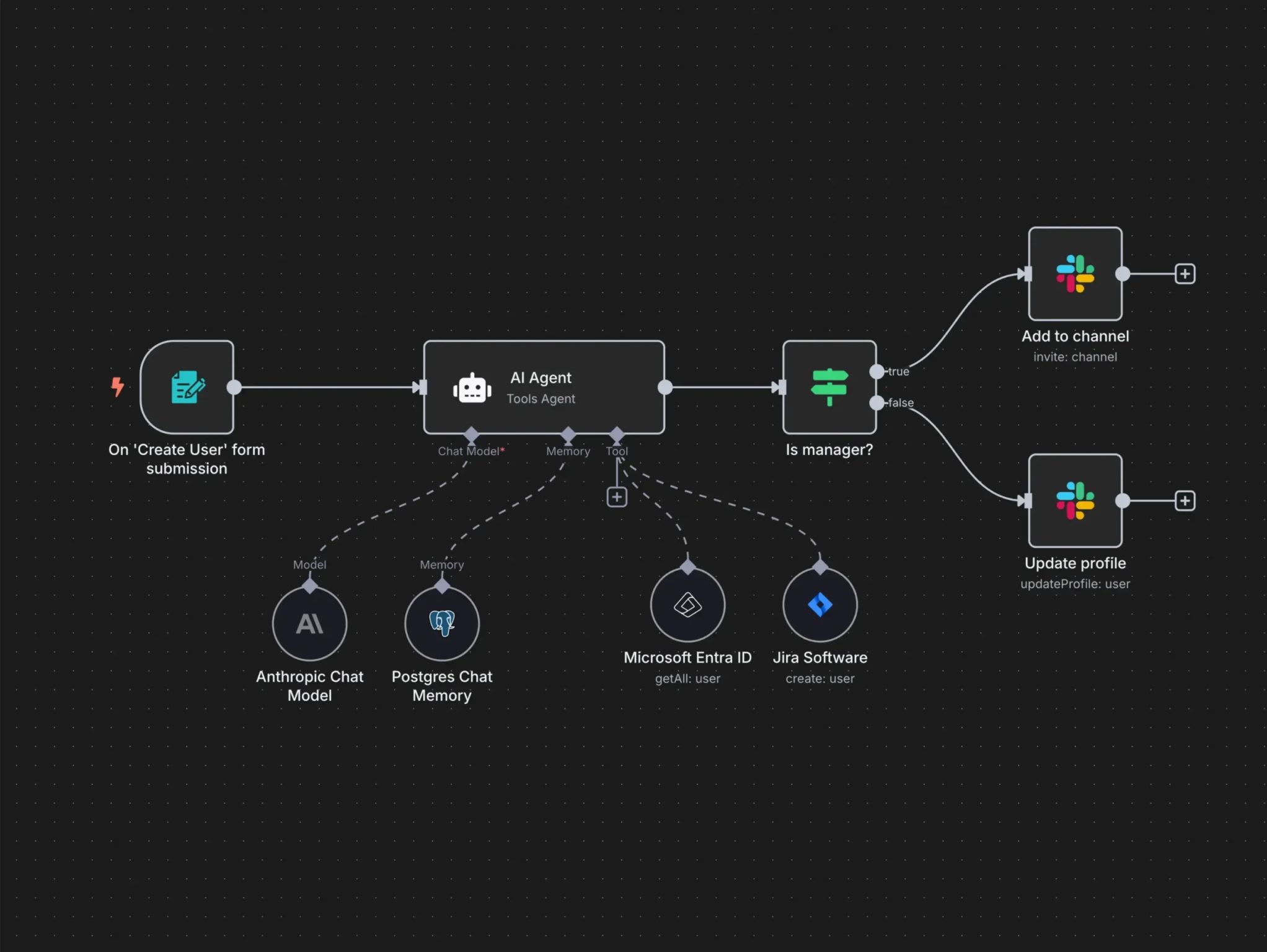
There's a screenshot that goes viral every few weeks on LinkedIn.
Someone has built an enormous n8n flowchart — dozens of nodes, arrows going everywhere, colour-coded paths branching off in every direction. The caption says something like: "Just built my AI agent in n8n. It handles my entire business."
And in the comments, hundreds of people are either impressed or intimidated, thinking that the flowchart is the agent.
It's not.
The flowchart is just the pipes. What matters is what flows through them — and whether anything intelligent is actually running the decisions.
What n8n Actually Is
n8n is a workflow automation platform. It lets you:
- Connect APIs — link tools like Gmail, Slack, Airtable, HubSpot, and hundreds more
- Trigger workflows — kick off a sequence when an event happens (a form submitted, an email received, a webhook fired)
- Move data between systems — take an output from one tool and feed it as an input to another
Think of n8n like the electrical wiring in a building. The wiring connects every room. It carries power from room to room. But the wiring itself doesn't do anything intelligent. It doesn't decide which lights to turn on. It doesn't know that someone just walked into the kitchen.
n8n is the wiring. You still need to decide what it carries — and where.
And you can plug an AI model into n8n. Many people do. But adding an AI node to a flowchart doesn't make the flowchart an AI agent. That's like saying a room with a smart bulb is an intelligent building.
Then What Is an AI Agent?
An AI agent is not a tool. It's not a platform. It's not a flowchart.
An AI agent is a piece of logic that does four things in sequence:
- Reads input — receives information (a message, a form, an event, a database record)
- Decides what to do — reasons about the input and determines the appropriate next step
- Uses tools — calls whatever it needs to execute that step (search, write, send, calculate)
- Takes action — actually does something in the world that produces an outcome
That logic can live inside n8n. It can also live in a Python script. A JavaScript function. A Go service. A LangChain chain. An Anthropic API call wrapped in 50 lines of code.
The platform is irrelevant. The logic is everything.
Here's the analogy: a chef and an oven. The oven provides heat — controlled, consistent, adjustable. n8n provides infrastructure — connections, triggers, routing. But the chef is the one who decides what to cook, in what order, at what temperature, with what ingredients.
The AI agent is the chef. n8n is the oven. You can also cook over an open fire (pure code) — it's harder to set up, but the meal can be identical. Some chefs prefer it.
The Real Numbers Behind This Confusion
The reason so many people conflate n8n with "AI agents" is partly because n8n has genuinely dominated the conversation.
n8n captured 90% of mentions among automation platforms tracked in 2025 — 1,387 out of 1,544 identified platform mentions. Its GitHub repository has crossed 184,000 stars and the community has grown past 200,000 members. (Source: State of AI Automation 2025, Felix Kemeth on Medium)
When one tool dominates that loudly, it's natural for people to associate the category with the tool. But tool popularity and category definition are different things.
What's actually happening underneath all those n8n flowcharts? Nearly 30% of automations now use agent-based architectures — meaning the workflows aren't just moving data anymore, they're making decisions. (Source: State of AI Automation 2025)
That's the actual shift. Not the tool. The architecture.
Why This Distinction Matters in Practice
Here's a real scenario. A fashion company wants to automate supplier follow-ups.
The non-agent version (n8n doing what n8n is good at): Every Monday at 9am, pull a list of pending supplier orders from Airtable → send a templated follow-up email via Gmail → log the action in Notion.
This is valuable. It saves 2–3 hours per week. It's reliable. But it's not an agent — it's a scheduled pipeline. It doesn't read the context of each supplier relationship, decide whether a follow-up is appropriate, or adjust its tone based on how overdue the order is.
The agent version (logic running the decisions): Receive a webhook when a supplier order has been pending for more than 5 days → pass the order details and supplier history to an LLM → the LLM reasons: "This supplier has missed deadlines twice before and the order is for our peak season. Escalate, don't just follow up." → sends an escalation message with specific language, logs the decision with a reason, flags it for review.
The second version requires real intelligence. That intelligence — the reading, the reasoning, the deciding — can be built in n8n if you use it correctly. It can also be built in pure code. The point is that the intelligence has to exist somewhere. The tool doesn't provide it automatically.
What Happens When You Build in Code Instead
Everything n8n does can be written in code. Every single thing.
Connecting an API? That's a fetch call or an SDK import.
Triggering on an event? That's a webhook listener.
Routing data between systems? That's logic.
The difference is that when you write it in code:
- You handle retries yourself
- You handle errors yourself
- You handle rate limits yourself
- You have complete flexibility in the logic
- You have no vendor dependency
n8n handles all of that for you — which is genuinely valuable when you're moving fast, prototyping, or building simple pipelines. But it's not magic. It's convenience.
I've been building these systems directly in code — inside a fashion company, automating real operations. No n8n. Just clarity on what to automate and how the workflow actually works.
The result? The same outcomes. No monthly platform subscription. No visual editor to explain to someone else. Just a system that runs.
The Market Confirms This Shift
The enterprise world has noticed that the intelligence layer, not the tool layer, is what creates value.
57% of companies already have AI agents running in production — and another 44% are planning deployment. (Source: G2 Enterprise AI Agents Report, via Master of Code)
The global AI agent market is projected to grow from $5.1 billion in 2024 to $47.1 billion by 2030 — a 44.8% CAGR. (Source: Master of Code AI Agent Statistics)
Process automation delivers an average 240% ROI within 12 months, with breakeven typically occurring within 2–4 months of deployment. (Source: Automation Atlas ROI Benchmarks 2026)
But notice what those numbers measure: outcomes from automation, not outcomes from any specific tool. The ROI comes from what the agent does — not from which platform hosts it.

The Four Things Every Actual Agent Needs
Whether you build in n8n, in code, or on any other platform, an AI agent that actually works needs all four of these:
1. Perception — a way to receive and parse input. A message, a database query, an API event, a document. Without this, the agent has nothing to act on.
2. Reasoning — a model or logic layer that interprets the input and decides what response is appropriate. This is usually where an LLM sits. Without this, the agent has no intelligence.
3. Tools — capabilities the agent can invoke. Search the web, send an email, write to a database, call an external API. Without these, the agent can think but can't act.
4. Action + Memory — the ability to execute, log what it did, and carry context forward. Without this, the agent has no persistence and no learning.
An n8n flowchart can implement all four of these. So can a 200-line Python script. The question to ask about any "AI agent" you see is: where are these four things actually happening?
If the answer is "the LLM node just summarises the data and the rest is all routing" — that's automation with an AI garnish. Valuable, but not an agent.
If the answer is "the LLM receives the full context, makes a decision, selects which tool to use, and takes an action based on reasoning" — that's an agent. The platform it runs on is a secondary concern.
Tools Are Optional. Understanding Is Not.
The workflow automation market hit $23.77 billion in 2025 and is growing toward $37.45 billion by 2030. (Source: Mordor Intelligence Workflow Automation Market)
Gartner says 75% of new enterprise applications will be built using low-code technologies by 2026. (Source: Kissflow No-Code Statistics 2026)
These numbers mean more businesses will pick up n8n, Make, Zapier, or something equivalent to start automating. That's good. These tools lower the barrier.
But lowering the barrier to building something and lowering the barrier to understanding something are not the same thing.
The founders who move fastest are not the ones who learned n8n first. They're the ones who first answered:
- What process is slow, repetitive, and rule-based enough to automate?
- What decision needs to be made in that process?
- What information does that decision require?
- What action follows from that decision?
Once you can answer those four questions, you can build the agent in n8n. Or in code. Or by describing it to someone who builds it for you.
The tool choice comes last. The thinking comes first.
Frequently Asked Questions
1. What is n8n and what is it used for? n8n is an open-source workflow automation platform that lets you connect APIs, trigger automated sequences based on events, and move data between systems using a visual flowchart interface. It's used for tasks like syncing CRMs, sending automated emails, processing form submissions, and routing data between business tools. It can include AI capabilities, but it is an infrastructure tool, not an AI agent itself.
2. What is the difference between n8n and an AI agent? n8n is a platform for connecting tools and routing data. An AI agent is logic that reads input, reasons about it, and takes autonomous action. You can build an AI agent inside n8n by adding reasoning and decision-making logic. But n8n alone — without that layer — is just intelligent plumbing. A flowchart with branching paths is not the same as a system that decides which path to take based on context.
3. What does an AI agent actually consist of? An AI agent has four components: perception (how it receives information), reasoning (how it decides what to do), tools (what it can use to act), and action/memory (how it executes and retains context). Any implementation — n8n, Python, LangChain, direct API calls — that covers all four is a legitimate agent architecture. Most no-code "agents" only implement routing and miss the reasoning layer.
4. Can you build real AI agents without n8n or any no-code tool? Yes. Everything n8n does — API calls, event triggers, routing logic, data transformation — can be implemented in code. The tradeoff is that you handle retries, errors, and rate limits yourself, but you gain full control, flexibility, and no platform dependency. For simple pipelines, n8n saves significant time. For complex, customised systems, code often produces cleaner, more maintainable results.
5. Is n8n worth learning in 2025 and 2026? Yes, for the right use cases. n8n has captured 90% of automation platform mentions in 2025 and has over 184,000 GitHub stars and 200,000+ community members — it's the dominant visual automation tool. For connecting APIs quickly, building prototypes, or automating simple pipelines, it's extremely productive. The caution is not to mistake learning n8n for learning how to build AI agents — those are related but different skills.
6. What are the limitations of n8n for building AI agents? According to analysis from Latenode, n8n relies on manual configurations and lacks native support for persistent memory, autonomous planning, and dynamic decision-making — which are core capabilities of a true agent. You can work around these limitations with custom code nodes and external databases, but that requires programming knowledge. At that point, you're essentially writing code inside a visual wrapper.
7. How much does workflow automation actually save businesses? Process automation delivers an average 240% ROI within 12 months, with breakeven typically within 2–4 months. Intelligent automation (where AI reasoning is involved) reduces operating costs by 50–70%, compared to 20–30% for basic rule-based automation. 74% of employees report working faster after automated workflows are deployed. (Source: Automation Atlas, Kissflow)
8. How do AI agents make decisions — can they really "think"? AI agents use large language models (LLMs) as their reasoning core. The LLM receives context — the input data, the available tools, the goal — and produces a decision: which tool to use, what to say, whether to escalate. It's not "thinking" in a human sense, but it is contextual reasoning that goes beyond simple if-then rules. The quality of the agent depends on how well the context is provided and how clearly the goal is defined.
9. What kind of tasks are actually worth automating with AI agents? The best candidates are tasks that are: (1) high volume — happens frequently enough to justify setup time; (2) rule-based at some level — even if the rules are fuzzy; (3) dependent on external data — needs to pull or push from other systems; and (4) currently done manually — a human is doing something that takes time and is prone to delay. Follow-ups, reminders, data extraction, classification, report generation, and routing decisions are the most common starting points.
10. What should a founder do before picking an automation tool? Map the actual workflow first. Write down: what triggers the process, what information is needed, what decision gets made, what action follows, and what gets recorded. This takes 30–60 minutes and saves weeks of building the wrong thing. Once you have that map, the tool choice is straightforward — n8n if speed of setup matters, code if control and customisation matter. The tool should fit the workflow, not the other way around.
11. Is the AI agent market real or just hype? The adoption data suggests it's real. 57% of companies already have AI agents running in production (G2, 2025). The global AI agent market is growing from $5.1 billion in 2024 to a projected $47.1 billion by 2030 at a 44.8% CAGR. A MIT Sloan and BCG survey found 35% had already adopted AI agents with another 44% planning to. That is not hype — that is mainstream enterprise deployment happening right now.
12. Why do so many "AI agents" built in n8n underperform? Because they're built tool-first, not problem-first. The builder starts with the visual editor, adds nodes, connects APIs, drops in an LLM node for good measure — and ends up with a workflow that technically includes AI but doesn't actually use it for anything meaningful. Real agent performance comes from clearly defining the decision the agent needs to make and giving the reasoning layer enough context to make it well. Most implementations skip that design step entirely.
The next time someone shows you a sprawling n8n flowchart and calls it an AI agent, look for the reasoning layer.
Where does it read the actual context? Where does it make a decision that couldn't be captured in a simple if-then rule? Where does it choose between options based on something that varies?
If you can find that — it's an agent. If you can't — it's automation with AI branding.
Both are useful. But only one of them will actually get smarter over time.
Building systems like this for a real business — not a demo, not a template, not a YouTube tutorial workflow. If you're a founder who wants to understand what's actually worth automating and how to build it right, send a message on WhatsApp.